Subsection 2.4 How Self-Attention Supplies Context
The academic paper that introduced the transformer architecture was called Attention Is All You Need. So what is “attention” and why is it so important? This section explores what attention is and how it works in the context of a transformer based system like like GPT-2.
Subsubsection 2.4.1 Self-Attention at a High Level
Consider the phrase
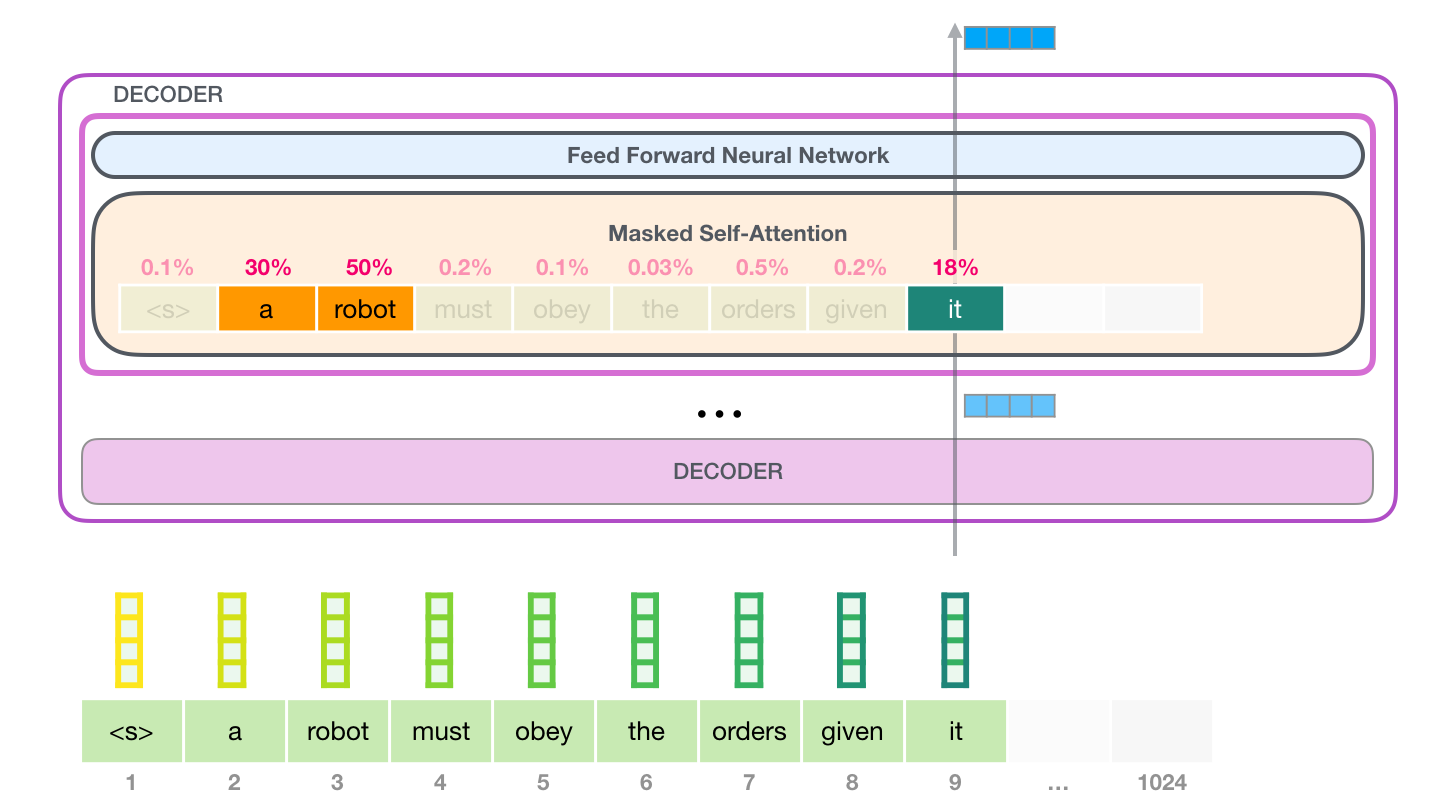
A robot must obey the orders given it. What does it refer to? A human reader sees that it refers to a robot, several tokens earlier. GPT-2 needs to be able to do the same trick. As it processes it, the tokens for a and robot should be given particular importance in its representation. Other parts of the context like orders are less relevant to understanding what it refers to. Self-attention is the mechanism that allows the model to focus on relevant parts of the context when processing a token.
In this illustration, the attention pattern puts most of its weight on
a robot:
Subsubsection 2.4.2 Self-Attention Process
Self-attention is processed along the path of each token in the segment. The significant components are three vectors:
-
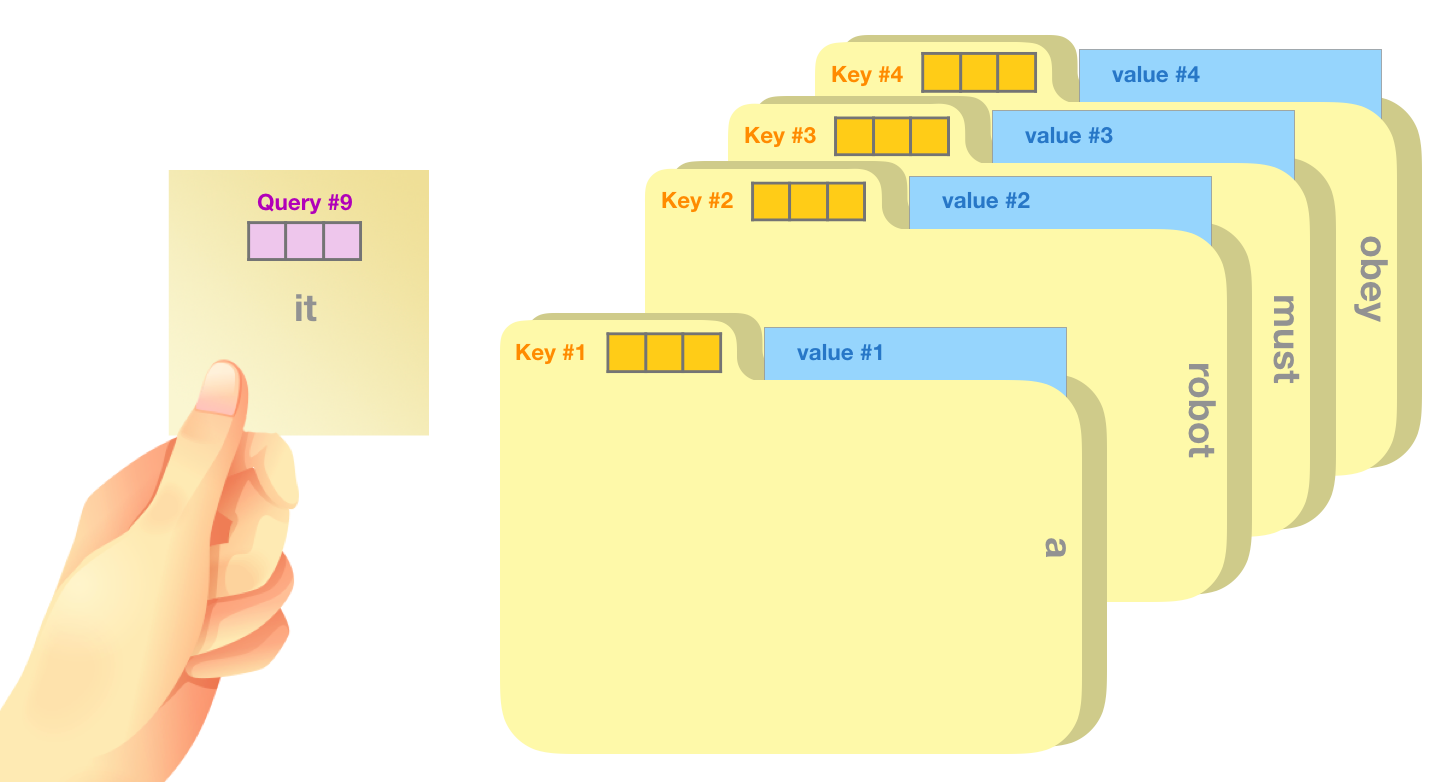
Query. What am I looking for? The query represents the current token. It is the thing that we are trying to understand. Given the token
bankthe query would be an embedding representing possible meanings of the word “bank” (financial institution, geographical feature of a waterway). -
Key. What can I offer? Key vectors act as labels for all the tokens in the context. The key vectors are matched against the query to identify what is relevant to that particular query. The word
riverwould have a key vector that represents the fact that it offers context about waterways. -
Value. What information do I actually hold? Value vectors contain token representations. After relevance scores are calculated, a weighted sum of these vectors represents the current token in context. For our example, the value vector for
riverwould contain information about the characteristics of a river.
A filing cabinet provides a good analogy. The query is a note describing a topic, keys are folder labels, and values are folder contents. Matching the query to the labels identifies relevant contents. Attention combines contents from multiple folders rather than selecting only one.
Subsubsection 2.4.3 The Mathematics of Attention
This matching of queries to keys is done mathematically by a series of matrix operations and mathematical transformations. We will not cover every detail of these operations, but it is worth understanding at a high level how information flows through the attention mechanism.
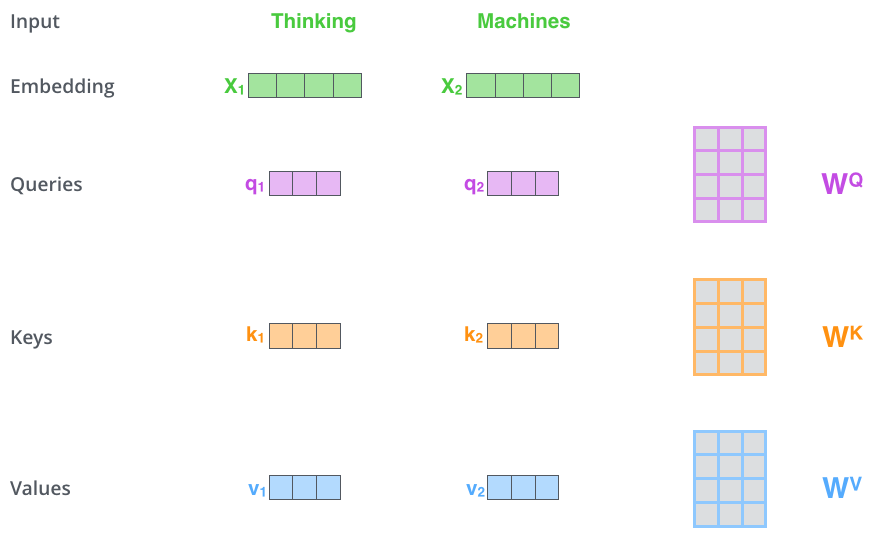
Part of what the language model learns as it is trained are weight values to use in these matrix operations. In the diagram below, \(W_Q\text{,}\) \(W_K\text{,}\) and \(W_V\) are learned weight matrices that transform an input vector into query, key, and value vectors. Given two tokens, \(x_1\) and \(x_2\text{,}\) their query, key, and value vectors, \(q_1\text{,}\) \(k_1\text{,}\) \(v_1\text{,}\) \(q_2\text{,}\) \(k_2\text{,}\) and \(v_2\text{,}\) are produced by applying the respective weight matrices to the input vectors.
To calculate a representation for a given token, like machines in this example (\(x_2\)), the model takes that query, and for each token, combines the query with the relevant key to compute an attention score. A softmax function is applied to these scores to weight them so that when summed, they make 1, representing 100% attention. These scores are then used to weight the value vectors, which are summed to produce the final representation for the token. In the diagram below, the final output for
machines is shown as \(z_2\) and was calculated by adding the weighted value vectors \(v_1\) and \(v_2\text{:}\)
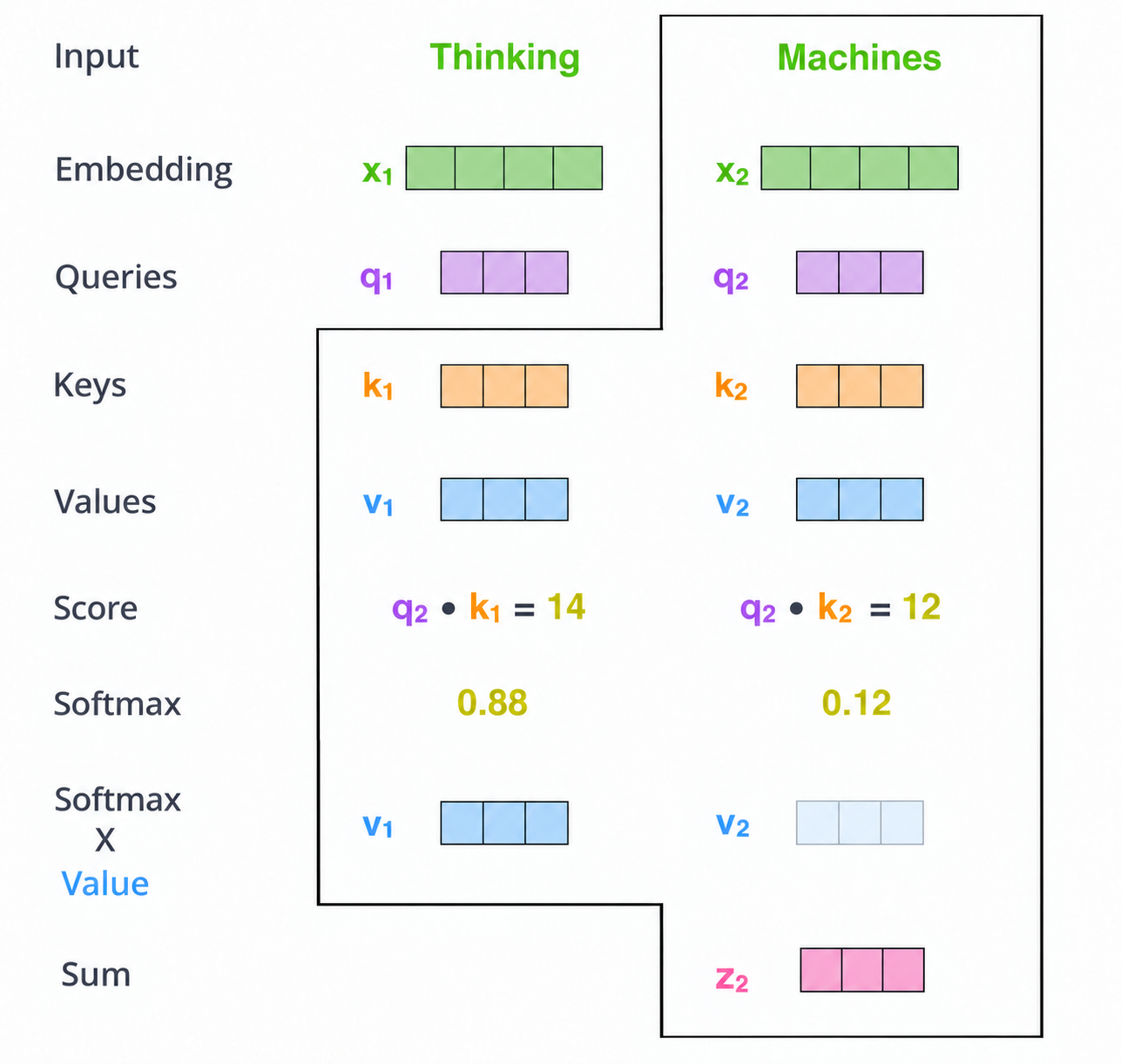
GPT-2 performs this calculation separately in each attention head, using only positions allowed by its mask. The decoder-block section below shows how it combines the heads.
Subsubsection 2.4.4 Masking Future Tokens
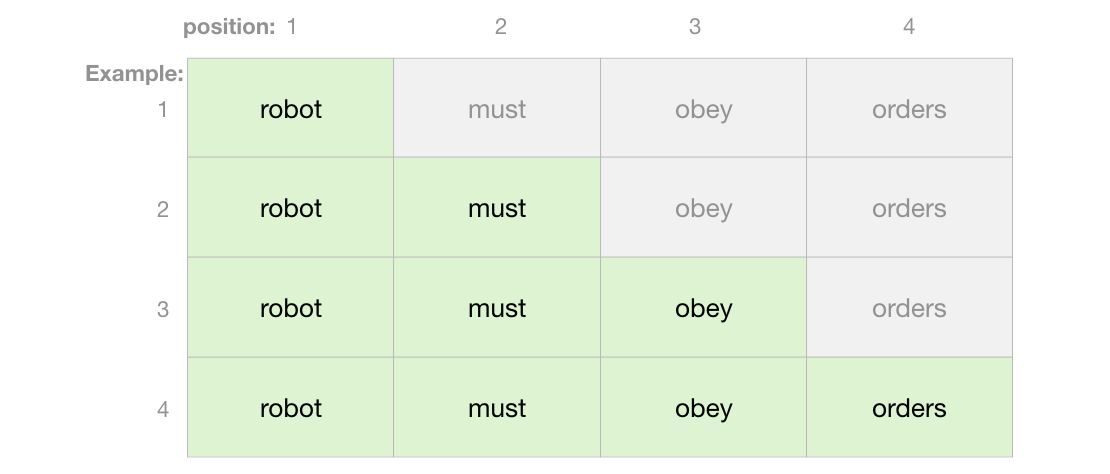
Masked self-attention refers to the idea that while processing a token, only previous tokens are allowed to influence the current token. Consider the sequence “robot must obey orders”. When we form the representation for
must, we only want the model to use the information from robot. When forming the representation for obey, it can use information from both robot and must.
The diagram below shows the attention mask for the four words. Grayed out squares represent tokens that should not be considered when processing the current token (ones that are masked). Notice how the mask is triangular, allowing each token to attend to itself and all previous tokens, but not to any future tokens.
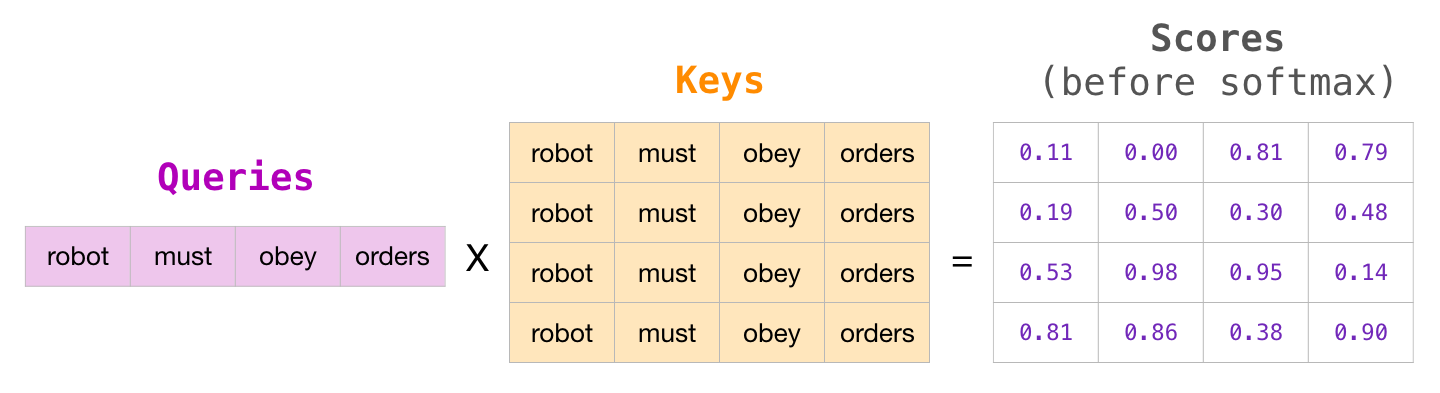
The math for calculating the attention scores is done in matrix form, combining the application of all the query tokens to all the possible keys as one large matrix multiplication. This results in a matrix of scores where each row corresponds to a query token and each column corresponds to the calculated attention score for a key:
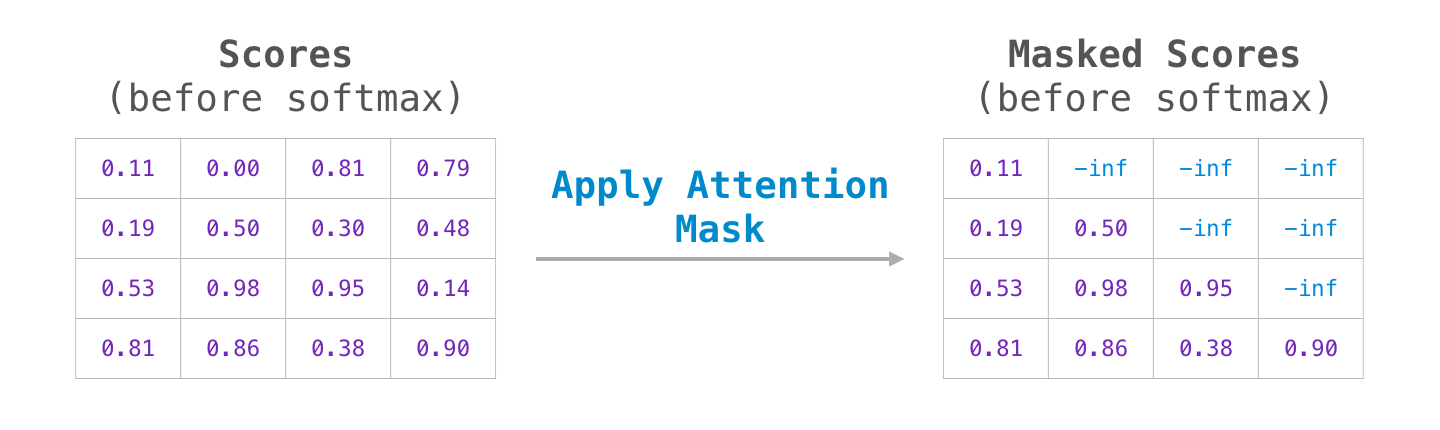
To apply the mask, we want to “turn off” the attention scores for the masked entries. We can do that by setting the values that should be ignored to negative infinity or a very large negative number (such as -1 billion in GPT-2):
Applying softmax to each row produces the attention weights. Anything that was given a negative infinity value will have a weight of 0:
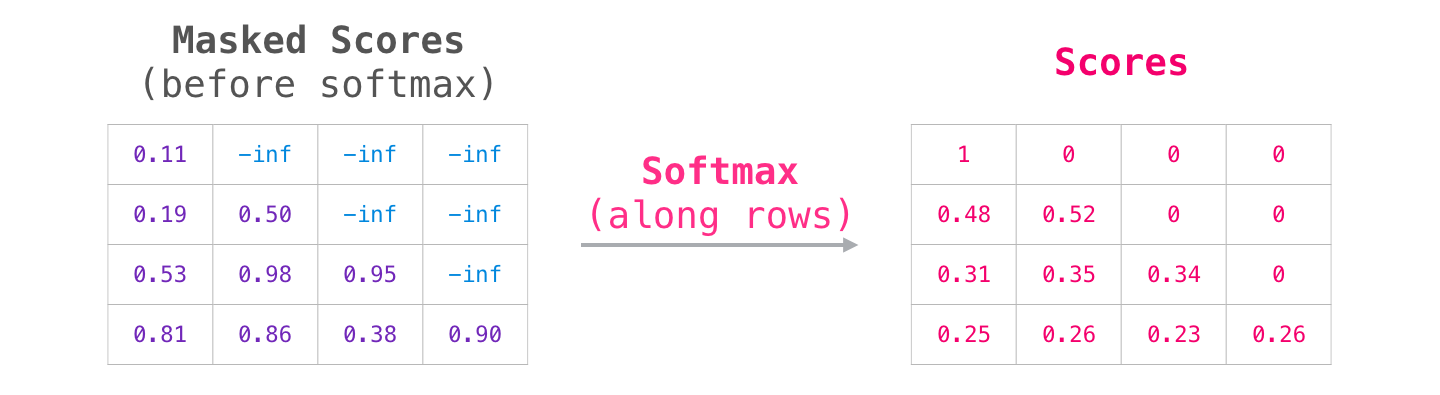
What this scores table means is the following:
-
When the model processes the first example in the dataset (row #1), which contains only one word ("robot"), 100% of its attention will be on that word.
-
When the model processes the second example in the dataset (row #2), which contains the words ("robot must"), when it processes the word "must", 48% of its attention will be on "robot", and 52% of its attention will be on "must".
-
And so on.

